Wednesday, August 6, 2014

Required HSE Supervisor for Dubai- 5 Years experiance

HSE Supervisor
Node Contracting LLC

Location               :Dubai
Date                      :09-07-2014
Job Type              :Employee
Job Status           :Full Time
Categories          :Engineering & Construction Managerial

Job Details
HSE Supervisor, with minimum 5 years experience, preferably with driving licence, required for a contracting company. Please email CV to: nclrecruitment2014@gmail.com


Article Source:  http://www.gncareers.com/jobs

Monday, August 4, 2014

How to Write a Risk Assessment


A risk assessment is a document that helps a company identify any hazards or unsafe practices in the workplace in order to avoid employee injuries. It's common sense that the fewer accidents a company has, the more productive it will be. Use these tips to learn how to write a risk assessment for your company or organization.


1List the hazards that may be incurred when a task, job or process is completed in your workplace. To identify a hazard, you may observe it, experience it or learn about it by interviewing other workers. Examples might include slipping obstacles or fire hazards.


2 Determine the level of risk of each hazard identified. Risk may be determined by multiplying the likelihood of an accident occurring times the severity of the result. Likelihood is rated on a scale from 1 to 5, 1 being highly unlikely and 5 being certain to occur. Severity is also rated on a scale from 1 to 5, with 1 being trivial injury to 5 being death. The higher the multiplication sum, the higher the risk.


3 Document the groups of people who may be at risk. Various personnel, including members of the public, office staff, machine operators, loading dock employees or maintenance personnel, may be affected by identified hazards. Special consideration should be given to employees who work individually, young employees, temporary staff and disabled workers.


4 Identify precautions already used to avoid hazards within the workplace. Safety gear, automatic shut-off functions and protective guards may already be in place to prevent accidents. Many workplaces use rubber mats to reduce slipping chances and install fire extinguishers within feet of machines


5 Coordinate new control methods for high risk situations. Many risk assessments recommend the elimination of a certain task or job in order to rid the workplace of that particular risk. Sometimes a new method can be substituted for a current activity. Many risk assessments suggest physical controls be put into place, such as guards to avoid access to machine parts or automatic shut-off switches on machines. Administrative controls that include new rules or policies may help avoid a hazard. Other times, employees are required to wear protective gear such as safety glasses, hard hats, gloves or protective body wear. Many risks can be avoided simply by identifying other methods to keep employees safe.


Remember

A risk assessment is only effective if you and your staff act on it. You must follow through with any actions required and review it on a regular basis.


Sample Risk Assessments:
1.    Office Cleaning:          http://www.hse.gov.uk/Risk/casestudies/pdf/officecleaning.pdf

Sources and Citations:    http://www.hse.gov.uk/pubns/indg163.pdf,                            
                                           http://www.wikihow.com/Write-a-Risk-Assessment

CARBON MONOXIDE & SAFETY TIPS

Although the popularity of carbon monoxide (CO) alarms has been growing in recent years, it cannot be assumed that everyone is familiar with the hazards of carbon monoxide poisoning in the home.

Often called the silent killer, carbon monoxide is an invisible, odorless, colorless gas created when fuels (such as gasoline, wood, coal, natural gas, propane, oil, and methane) burn incompletely. In the home, heating and cooking equipment that burn fuel are potential sources of carbon monoxide. Vehicles or generators running in an attached garage can also produce dangerous levels of carbon monoxide.

Facts & figures
·         The dangers of CO exposure depend on a number of variables, including the victim's health and activity level. Infants, pregnant women, and people with physical conditions that limit their body's ability to use oxygen (i.e. emphysema, asthma, heart disease) can be more severely affected by lower concentrations of CO than healthy adults would be.
·         A person can be poisoned by a small amount of CO over a longer period of time or by a large amount of CO over a shorter amount of time.
·         In 2010, U.S. fire departments responded to an estimated 80,100 non-fire CO incidents in which carbon monoxide was found, or an average of nine such calls per hour.  The number of incidents increased 96 percent from 40,900 incidents reported in 2003. This increase is most likely due to the increased use of CO detectors, which alert people to the presence of CO.

Article Source: Non-Fire Carbon Monoxide Incidents," by Ben Evarts, March 2012.


CARBON MONOXIDE SAFETY TIPS


Often called the silent killer, carbon monoxide is an invisible, odorless, colorless gas created when fuels (such as gasoline, wood, coal, natural gas, propane, oil, and methane) burn incompletely. In the home, heating and cooking equipment that burn fuel can be sources of carbon monoxide.

·         CO alarms should be installed in a central location outside each sleeping area and on every level of the home and in other locations where required by applicable laws, codes or standards. For the best protection, interconnect all CO alarms throughout the home. When one sounds, they all sound.
·         Follow the manufacturer’s instructions for placement and mounting height.
·         Choose a CO alarm that has the label of a recognized testing laboratory.
·         Call your local fire department’s non-emergency number to find out what number to call if the CO alarm sounds.
·         Test CO alarms at least once a month; replace them according to the manufacturer’s instructions.
·         If the audible trouble signal sounds, check for low batteries. If the battery is low, replace it. If it still sounds, call the fire department.
·         If the CO alarm sounds, immediately move to a fresh air location outdoors or by an open window or door. Make sure everyone inside the home is accounted for. Call for help from a fresh air location and stay there until emergency personnel.
·         If you need to warm a vehicle, remove it from the garage immediately after starting it. Do not run a vehicle or other fueled engine or motor indoors, even if garage doors are open. Make sure the exhaust pipe of a running vehicle is not covered with snow.
·         During and after a snowstorm, make sure vents for the dryer, furnace, stove, and fireplace are clear of snow build-up.
·         A generator should be used in a well-ventilated location outdoors away from windows, doors and vent openings.
·         Gas or charcoal grills can produce CO — only use outside.


Article Source: http://www.nfpa.org/safety-information

Sunday, August 3, 2014

Job Alert:

HSE Officer
Career Craft Consultany

Location                  :Dubai Investment Park
, Dubai
Date                          :30-07-2014
Payrate                     :3,000 To 4,000 Monthly (AED)
Salary Details        :Salary AED 3,000 - AED 4,000+ bachelor accommodation and 
                                       transportation Working hours 8 AM -6 PM (6 days a week, Friday off). 
Job Type                  :Employee
Job Status               :Full Time
Categories              :Engineering & Construction


Job Details
For a well established Steel Manufacturing industry looking for HSE Officer with  2-3 years experience in Industrial Environment (steel manufacturing will be an added advantage), for their office in DIP phase II. He MUST have good knowledge on HSE rules and regulations, UAE policy on health & safety, Diploma in HSE is a MUST. Salary AED 3,000 - AED 4,000+ bachelor accommodation and transportation. Working hours 8AM -6 PM (6 days a week, friday off). Candidates who agree on mentioned salary MAY ONLY APPLY. Please forward resume with recent photograph urgently to engineer@c3.ae

Article Source: gncareers.com


HEADACHE TYPES, METHODS OF DIAGNOSIS & TREATMENT


Did you know that about 60-70% of the world’s population suffer from headaches.
Did you know that there are 276 kinds of headaches.
90 percent of headaches called headache primary (Primary Headache), this type of headache is a disease in itself and is not an offer for another disease.It is caused by physiological or switches the function of the blood vessels, the brain’s pain centers and their organic chemical changes leading to the patient feeling pain.
Primary Headache
  • Post-traumatic stress headaches Tension Headache
It is most prevalent where the catch of 40-60% of patients with headache is caused by muscle contractions in the tensions of the scalp, neck and back and appears on the form feeling of tightening or pressure from weak to moderate force in several places of the head, especially in the rear.
  • Headaches migraine Migraine Headache
There was never such a sense of proximity or so-called aura is a change or temporary changes accompanied by numbness or heaviness in or speech disorder may continue this period of 30-60 minutes and follows the real headache is migraine-type sometimes accompanied by nausea or vomiting, the patient should avoid light and noise.
  • Cluster headaches Cluster Headache
This relatively rare occurrence and incidence among men in the prime of life, especially smoking.
And this kind more consecutive bouts often share the same side of the head accompanied by redness of the eyes, as well as nominated for the nose and the kind of intensity and not respond to painkillers known.
  • Heachaches Drug Overused Headache
This type produces the common use of analgesics by patients suffering from headache types listed above vary nature of pain from other types in that it often affects the entire head with a compressor or tug is this form of chronic headaches.
Secondary Headache secondary headaches
It constitutes about 10% of all headaches arise from many different causes for example headache caused by meningitis or cancerous tumors as well as thrombosis or cerebral bleeding, sinusitis, the sudden rise of internal pressure of the eye as well as the Castle or the astigmatism and dental problems and many other reasons.
By diagnosis and determine the reasons why
For this reason, these types of headaches should identify the type and cause headaches accurately so requires:
  • The history and evolution of the disease.
Clinical detection of central nervous system and peripheral by the consultant of Neurology.
  • Action plan for the brain EEg.
  • Head CT procedures such as CT (CT-Scan) or magnetic resonance imaging (MRI), which can show the brain tissue and functional and pathological changes.
In addition to laboratory tests if necessary.
Treatment methods
Different ways to treat headaches in the case of secondary headaches with causes in such cases is the direct causes which led to headaches.
As for the primary headaches vary depending on the type of headache treatments and therapies can be summarized as follows:
  • Instantaneous or simultaneous treatment when a spell, many available medicines and better deal with the doctor’s prescription.
  • Preventive treatment and regularly for a certain period of time to reduce the number of seizures.
Tips and guidelines for patients with headache
  • Take enough sleep and sleep and waking hours.
  • Regular meals and the adoption of appropriate quantity and quality.
  • Relaxation exercises from time to time.
  • Do not delay in taking medications prescribed by a physician.
  • No excessive use of sedatives.
  • Avoid stress and noise as well as emotions and mental tensions.
  • Consult your doctor, especially when a significant change in the nature and degree of headache.
Article Source: beztips.in

Saturday, August 2, 2014

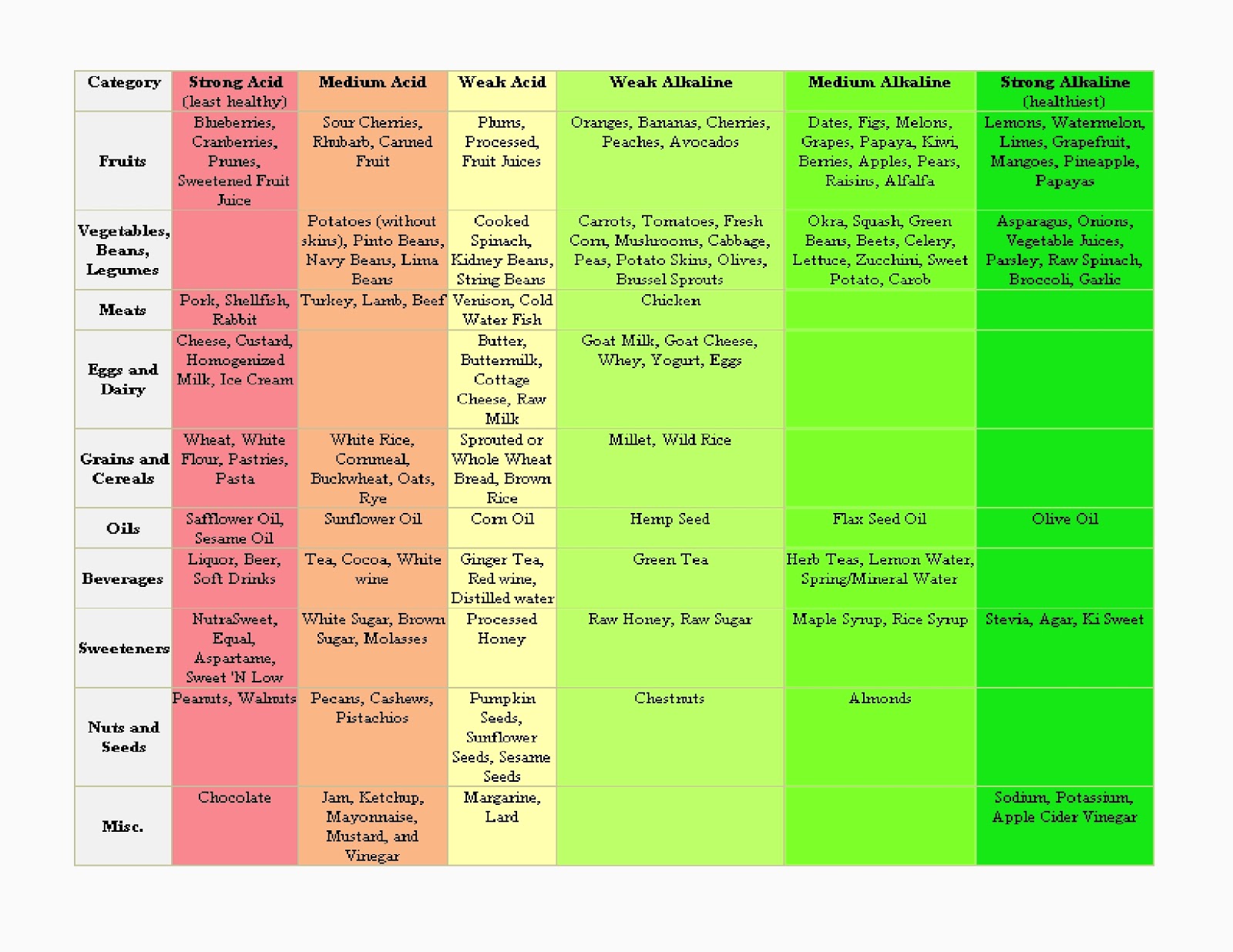
pH Food Chart


Alkalizing the body is probably the best thing that a person can do to ensure good health and well being. There is a direct relationship between a person's pH and the oxygen content of his blood, and a tiny change in pH can have dramatic effects upon a person's oxygen intake. An alkaline body pH will prevent diseases, and will cure existing ones by exponentially boosting a body's oxygen intake. As a general rule, pathogens and cancers cannot survive in an oxygen-rich, alkaline environment.

Alkalizing the body is not an easy task for most people, but the benefits are many. This chart shows the effects of various foods on the human body. As you may notice, the initial pH of the food is irrelevant. For instance, while lemons and limes are naturally acidic fruits, they have a strong alkalizing effect upon the body when processed in digestion. For more information on the benefits of alkalinity, read The Link Between Body pH and Disease. You should also watch our documentary, The Cancer Report.

Pharmaceuticals are usually inherently toxic to the human body, and they cause disruptions in the gastrointestinal tract. They often cause the stomach to poorly digest foods, which results in malnourishment. The lack of absorbed minerals offsets the pH of the body, which causes a cascading snowball effect in which it is less able to absorb other nutrients. In this state, the body is more vulnerable to sickness and cancers. The medical establishment describes the most toxic drugs as being strong. So, the stronger drugs are those which will imbalance the pH the most, and will cause cascading health problems.

We cannot fairly give credit to any person or group for the chart below, because it was compiled from, and verified with, dozens of sources. We welcome any verifiable information that could be used to expand this chart. Unfortunately, it appears that most foods have not yet been through the mineral testing required to definitively ascertain their pH-shifting properties.


Category
Strong Acid(least healthy)
Medium Acid
Weak Acid
Weak Alkaline
Medium Alkaline
Strong Alkaline(healthiest)
Fruits
Blueberries, Cranberries, Prunes, Sweetened Fruit Juice
Sour Cherries, Rhubarb, Canned Fruit
Plums, Processed, Fruit Juices
Oranges, Bananas, Cherries, Peaches, Avocados
Dates, Figs, Melons, Grapes, Papaya, Kiwi, Berries, Apples, Pears, Raisins, Alfalfa
Lemons, Watermelon, Limes, Grapefruit, Mangoes, Pineapple, Papayas
Vegetables, Beans, Legumes
Potatoes (without skins), Pinto Beans, Navy Beans, Lima Beans
Cooked Spinach, Kidney Beans, String Beans
Carrots, Tomatoes, Fresh Corn, Mushrooms, Cabbage, Peas, Potato Skins, Olives, Brussel Sprouts
Okra, Squash, Green Beans, Beets, Celery, Lettuce, Zucchini, Sweet Potato, Carob
Asparagus, Onions, Vegetable Juices, Parsley, Raw Spinach, Broccoli, Garlic
Meats
Pork, Shellfish, Rabbit
Turkey, Lamb, Beef
Venison, Cold Water Fish
Chicken
Eggs and Dairy
Cheese, Custard, Homogenized Milk, Ice Cream
Butter, Buttermilk, Cottage Cheese, Raw Milk
Goat Milk, Goat Cheese, Whey, Yogurt, Eggs
Grains and Cereals
Wheat, White Flour, Pastries, Pasta
White Rice, Cornmeal, Buckwheat, Oats, Rye
Sprouted or Whole Wheat Bread, Brown Rice
Millet, Wild Rice
Oils
Safflower Oil, Sesame Oil
Sunflower Oil
Corn Oil
Hemp Seed
Flax Seed Oil
Olive Oil
Beverages
Liquor, Beer, Soft Drinks
Tea, Cocoa, White wine
Ginger Tea, Red wine, Distilled water
Green Tea
Herb Teas, Lemon Water, Spring/Mineral Water
Sweeteners
NutraSweet, Equal, Aspartame, Sweet 'N Low
White Sugar, Brown Sugar, Molasses
Processed Honey
Raw Honey, Raw Sugar
Maple Syrup, Rice Syrup
Stevia, Agar, Ki Sweet
Nuts and Seeds
Peanuts, Walnuts
Pecans, Cashews, Pistachios
Pumpkin Seeds, Sunflower Seeds, Sesame Seeds
Chestnuts
Almonds
Misc.
Chocolate
Jam, Ketchup, Mayonnaise, Mustard, and Vinegar
Margarine, Lard
Sodium, Potassium, Apple Cider Vinegar


Article Source:
Written by , The Health Wyze Report

Granite Counter Tops Pose Health Risks


Granite counter tops are generally seen as a demonstration of high finances by the wealthy.  They frequently are dangerous because they are radioactive, and they emit radon gas.  This phenomenon is something that even the mainstream press has begun reporting.  The E.P.A. and other regulatory agencies have been receiving floods of phone calls from home owners and inspectors about unusually high levels of radiation from granite counter-tops.  As usual, people are urged to ignore the high readings as unimportant, because taking an official stance against radiation in kitchens would also imply that radiation used in modern medicine is also dangerous.  There is a great deal of money to be lost in several industries, in other words.

Some mainstream news sites parrot that the granite counter tops are probably safe, but the variations in radiation levels are extreme.  All granite counter-tops emit a small amount of radiation, but some are far higher than EPA 'recommended amounts'.  Despite the numbers being sometimes higher than EPA-allowable standards, the E.P.A. nevertheless maintains that granite counter-tops should not be a cause for concern.  You see, radiation from counter tops is safe.  It's the good kind of radiation, and it might even cure cancer.  Granite radiation is safe in much the same way that fluoride mystically becomes safe when mixed in drinking water or toothpastes.  It's F.D.A. science, once again.

Yet the EPA recommends that every house get checked for radon levels to, of course, detect how much healthy radiation homes are blessed with.  ABC News exposed that the Environmental Protection Agency does not even have a procedure for checking counter tops, which might explain some of their schizophrenia.  If they do not have any procedure, and presumably have not done any testing of their own, then we must wonder how they can possibly conclude that counter tops are safe.  Since the time of Madam Curie, we have clearly known what radiation exposure does to people.

The Marble Institute of America unsurprisingly claims that granite is completely safe, and distractedly focuses on other (much more negligible) sources of radiation in homes, such as that which "comes from soil or rock beneath the building".  They do admit that some of the newer varieties, particularly exotic kinds, have not been seen before, and are emitting the highest levels of radon gas and radiation.  Again, safety was declared before any investigation.

Famous bio-chemist, Linus Pauling, was one of the primary supporters of ending nuclear testing.  He maintained that radiation damage is accumulative.  Small amounts of radiation over an extended period is just as damaging as being exposed to all of it on the same day.  The human body never truly heals from it, or develops any natural defenses, and we're talking mutagenic damage at the DNA level.  He later won (one of his) Nobel Prizes for his work in convincing governments of the dangers of radiation exposure.  Even tiny amounts of radiation should be avoided whenever possible, and you may not even want to know what microwave ovens, Pepto-Bismol, and commercial mayonnaise do.

We recommend that those with granite counter tops test the radiation and radon levels in their kitchens, to ensure that they are not at increased risks of cancer, birth defects, or a plethora of other health effects that are routinely caused by radiation.


Article Source:
Written by , The Health Wyze Report